
INI Monitor
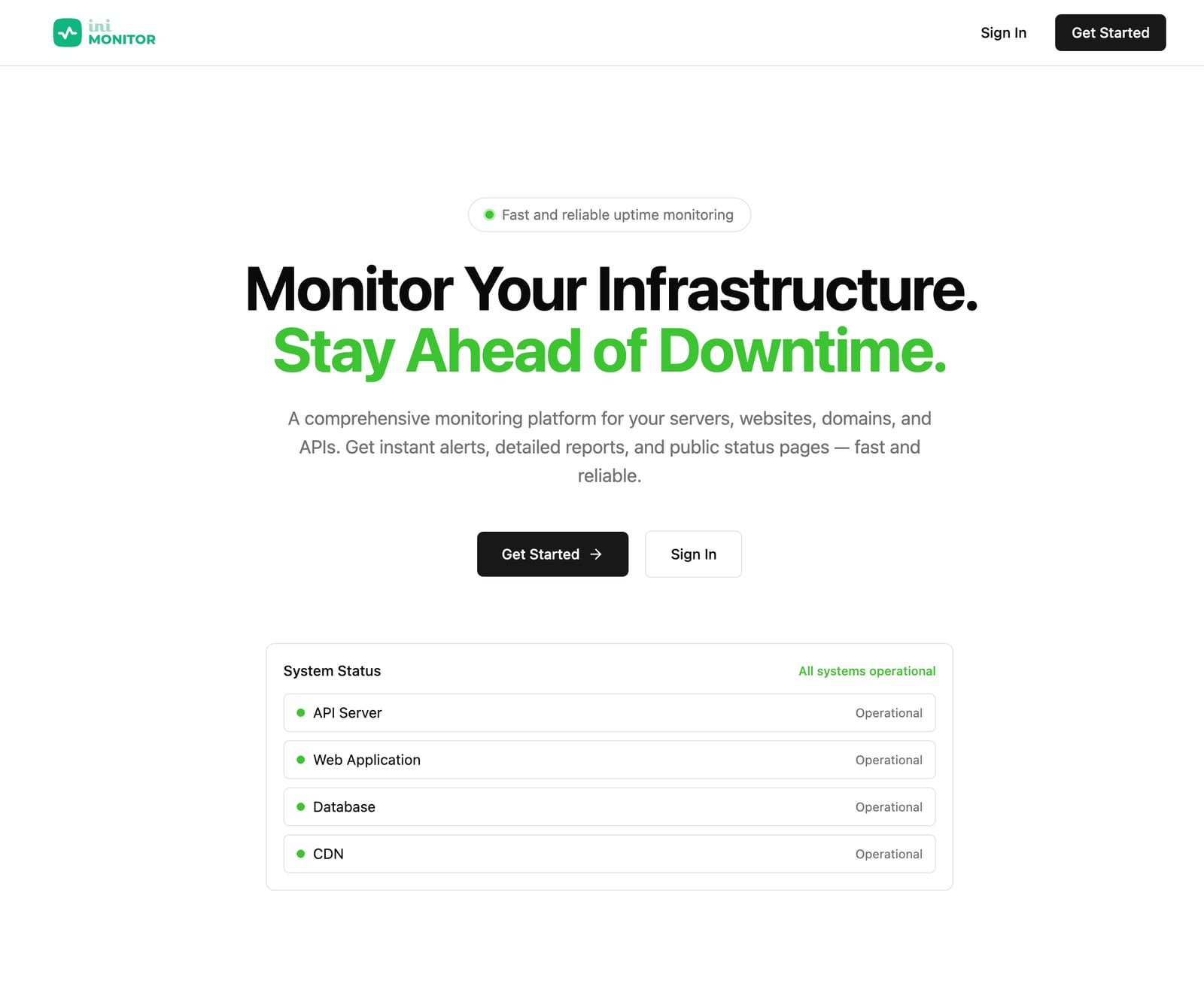
Know the instant something breaks, slows down, or is about to expire — real-time uptime, SSL, domain, server, and cron monitoring in one dashboard, with automated incidents, SLA reports, and branded public status pages.
Problem it solves
Downtime is expensive, and the root causes are scattered — expired SSL certificates, silent cron failures, DNS drift, overlooked domain renewals, and servers running out of disk. Teams cobble together four or five separate tools to cover them. INI Monitor replaces that stack with one real-time dashboard.
Who it is for
SaaS teams, agencies managing client portfolios, DevOps/SRE engineers, e-commerce operators, and IT managers — anyone who needs to keep services online and prove it.
Features
What's inside.
13 capabilities across the product.
- Six check types: HTTP/HTTPS, ping (IPv4/IPv6), TCP port, DNS, heartbeat, and a server agent
- SSL certificate, WHOIS, and DNS monitoring with smart expiry polling and change detection
- Real-time WebSocket dashboard with sparklines, 24h/7d/30d uptime, and active incident counts
- Automatic incident management with start/resolve times, duration, and MTTR-oriented history
- Multi-channel alerting: email, webhook, ntfy.sh, and Apprise fan-out to 80+ services (Slack, Discord, Telegram, PagerDuty, and more)
- Configurable cooldowns, recovery notifications, and repeat intervals to prevent alert fatigue
- Branded public status pages with custom slug, logo, light/dark theme, and incident history
- Reports with SLA views, P50/P95/P99 response-time percentiles, and CSV export
- Maintenance windows to silence alerts and pause checks during planned work
- AI assistant for plain-English monitor creation and status queries
- Server monitoring agent for CPU, RAM, disk, network, and uptime metrics
- Heartbeat monitoring for cron jobs, backup scripts, and scheduled tasks
- Per-monitor team sharing, 2FA with TOTP, and full REST API with revocable keys
Questions
Common questions.
What can I monitor?
Websites and APIs (HTTP/HTTPS with status, body, header, and auth validation), network reachability (ping IPv4/IPv6), TCP ports, DNS records, scheduled job heartbeats, and full server metrics via a lightweight agent — CPU, RAM, disk, network, and uptime.
Do you offer public status pages?
Yes. Spin up a branded page in minutes — custom slug, logo, light/dark theme, configurable history window, uptime percentages, response times, and incident history. You choose which monitors to expose and whether the page is public or private.
How does alerting work?
Multi-channel by design — email, webhooks, ntfy.sh, and Apprise (which fans out to 80+ services including Slack, Discord, Telegram, PagerDuty, and Pushover). Configure cooldowns, recovery notifications, repeat intervals, and test each channel before deploying.
Can I automate it or integrate with my tools?
Yes. A full REST API with revocable API keys lets you script monitor creation, pull metrics into Grafana, wire incidents into your own tooling, or bake checks into CI/CD. There is also an AI assistant that accepts plain-English commands like "add a monitor for example.com every 5 minutes".
What about maintenance windows and SLA reporting?
Schedule maintenance windows to suppress alerts, pause checks, and optionally show upcoming work on your status page. For SLA reporting, you get uptime percentages, P50/P95/P99 response-time percentiles, MTTR analytics, and CSV export across any time range.